

Mental Health Theories and Models for Academic Assignments
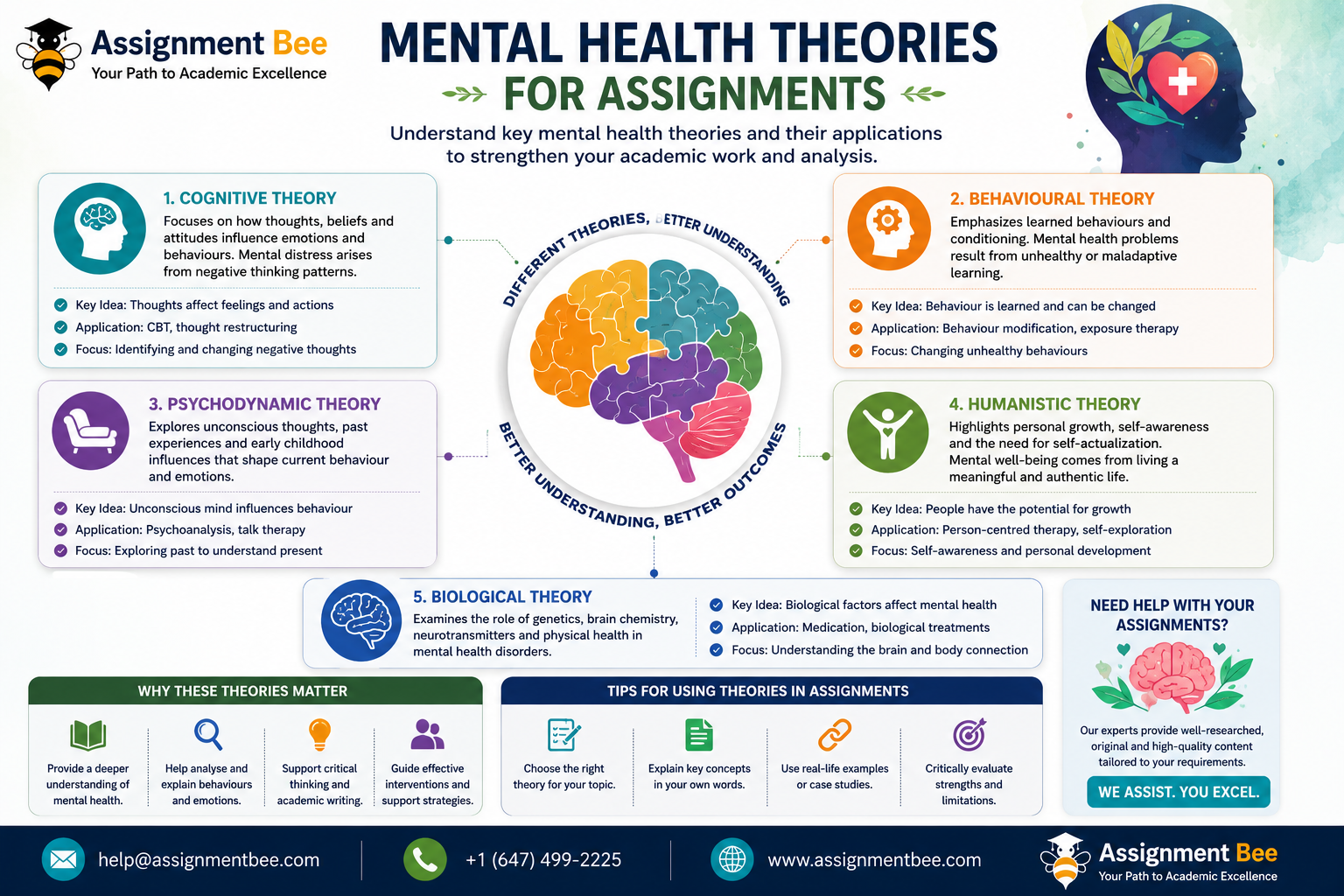
This infographic explains major mental health theories and models, including cognitive, behavioural, psychodynamic, humanistic, and biological perspectives used in psychology and health studies.
What Are Mental Health Theories?
Mental health theories are significant for academic assignments as they help students to explain human behaviour, psychological disorders and emotional well-being with the help of evidence-based frameworks. In the direction of nursing, psychology, social work courses, and counselling, the use of theoretical models is common for analysing the experiences of patients, evaluating treatment approaches, and enabling critical discussion. Moreover, understanding the above theories helps students to generate more academic and analytically credible assignments.
Biological Theory of Mental Health
One of the highly significant applied theories is the biological theory of mental health. This theory reveals that mental illnesses have a relation with genetic, chemical and neurological factors associated with the brain. Further, conditions like depression and schizophrenia are often linked with neurotransmitter imbalance and hereditary impact (Zigmond, Wiley and Chesselet, 2022). Moreover, the biological approaches support the application of medication and medical interventions during treatment. However, critics also argue that this theory overlooks the social and environmental impact.
Cognitive Theory of Mental Health
Another significant framework is the cognitive behavioural theory, that is designed by Aaron Beck. Cognitive theory helps to understand that negative thoughts and distorted patterns in thinking affect emotions and behaviours (Beck, 2019). For instance, individuals who experience anxiety may interpret situations as more threatening than they seem to be in reality. A therapy named Cognitive behavioural therapy (CBT) is based on this theory and is broadly applied in the case of mental health services. This theory also provides strong evidence for supporting its effectiveness.
Psychodynamic Theory Explained
Moreover, the psychodynamic theory, which was originally formulated by Sigmund Freud, emphasises unconscious thoughts as well as early childhood experiences. In the direction of this theory, unresolved conflicts originating from childhood may contribute towards problems in adult mental health (Colarusso and Nemiroff, 2013). However, the psychodynamic approaches influence modern psychotherapy; certain researchers criticise the theory due to the absence of scientific evidence.
The Biopsychosocial Model
On the other side, social theories in relation to mental health focus towards highlighting the impact of social environment, poverty, relationships, discrimination, and trauma. The social model also reveals that external factors like unemployment, social exclusion and stigma can influence mental well-being. This approach is specifically relevant for maintaining community mental health and executing the public health-oriented discussions.
Humanistic Theory and Wellbeing
Apart from this, the humanistic theory, in relation to Carl Rogers and Abraham Maslow, emphasises personal growth, individual potential and self-esteem. Humanistic approaches reveal empathy, self-actualisation and unconditional positive regard as significant aspects of mental wellbeing (Marlina, Ak and Mahmud, 2025). On the other hand, while writing assignments, students need critically not only describe the theories but also analyse them. Moreover, comparing strengths, practical applications and limitations also shows an extensive degree of academic skills. Further, the use of recent journal articles and evidence-specific literature also improves the academic discussion.
Overall, mental health theories also offer important frameworks to understand psychological conditions as well as guide professional practice. It is also found that a strong assignment combines theory with evidence, critical analysis and reflection.
The post Mental Health Theories and Models for Academic Assignments appeared first on .