

Charlotte Tilbury Marketing Strategy: Market Segmentation, 4Ps & Online Marketing
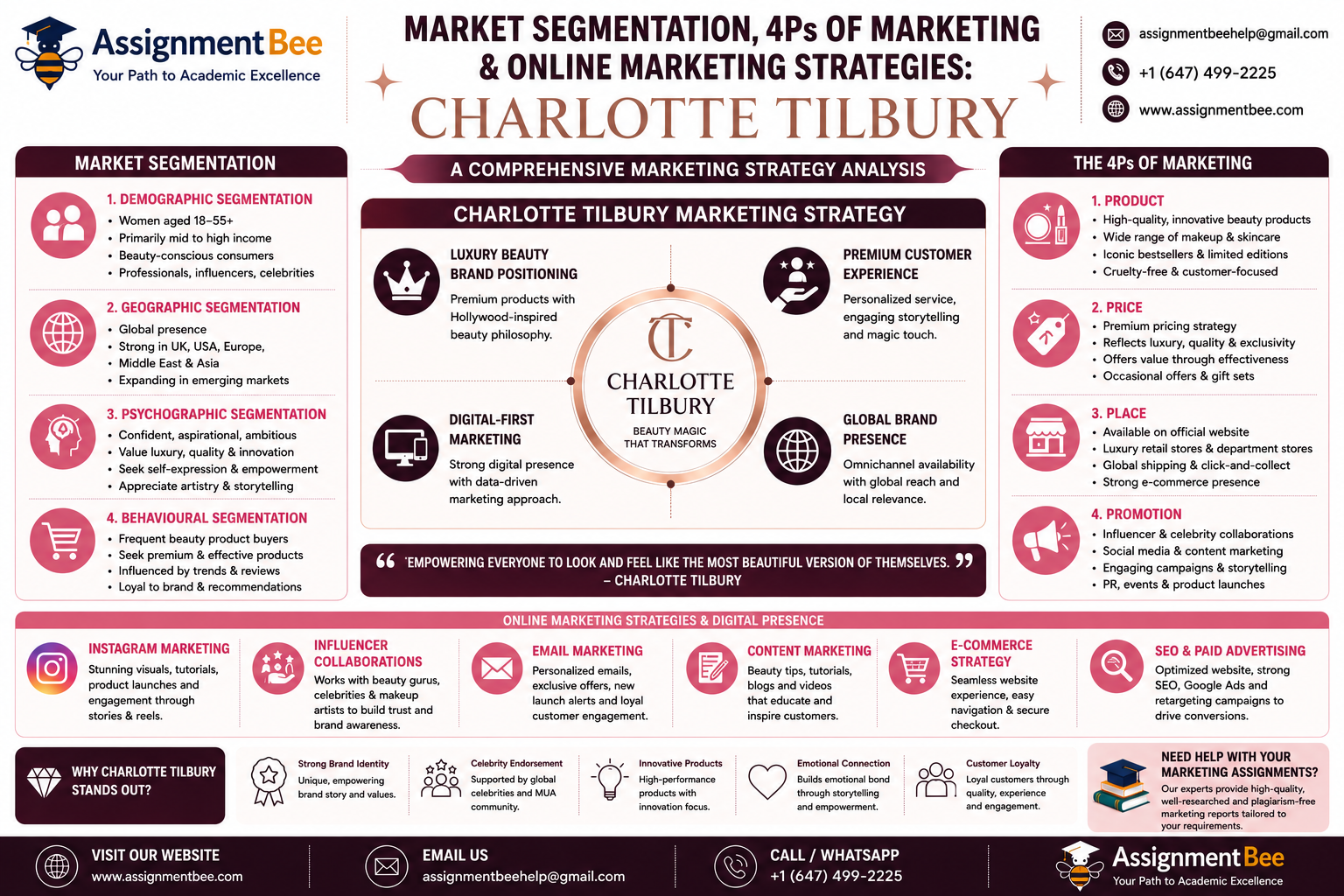
Explore Charlotte Tilbury’s marketing strategy, including market segmentation, the 4Ps of marketing, brand positioning, and online marketing strategies that drive global beauty brand success.
Charlotte Tilbury Marketing Strategy combines premium brand positioning, customer-centric marketing, and digital innovation to create a distinctive presence in the competitive beauty sector. By leveraging market segmentation, the 4Ps of marketing, and online engagement channels, the brand continues to strengthen customer loyalty and global growth.
Market Segmentation and Target Customers of Charlotte Tilbury
Market segmentation is the process of dividing a market into segments based on their attributes and needs, so that they can be targeted more efficiently (Kotler, Keller and Chernev, 2022). The luxury cosmetics market is the domain of Charlotte Tilbury, which is segmented into demographic, psychographic and behavioural segments.
The brand’s target audience is mainly female, between the ages of 25–54, and has medium to high disposable income. These consumers have multiple styles and are willing to pay higher price tags for high-quality beauty products and are very active in beauty and self-care trends. The business has also been tapping into the younger Generation Z audience with digital marketing and social media campaigns. Research indicates that younger luxury beauty shoppers are looking for brands that help them to express themselves, promote their social standing, and enable them to live out their aspirations (Singh and Nigam, 2021).
Glamour, confidence and luxury are the psychographic qualities that Charlotte Tilbury is looking for in its consumers. The brand sees beauty as a transformative experience, and it empowers and self-enhances with its products and marketing communications. The positioning of Charlotte Tilbury to their target customers is of great relevance as prestige, exclusivity and symbolic value are all significant factors that drive luxury cosmetics purchasing behaviour (Jaravaza and Moyo, 2024).
The company targets behaviourally people who are passionate about beauty, love to follow the trends, are active online and buy cosmetic products frequently. They are among consumers who are looking for innovative products and are likely to become loyal to brands that give them good experiences. In the luxury beauty sector, attachment to the brand and positive experiences can have significant effects on customer loyalty, as found by Ungarala (2021). Hence, Charlotte Tilbury’s segmentation approach is effective in reaching affluent, tech-savvy people who are after high-end beauty experiences.
Charlotte Tilbury Marketing Strategy :the 4Ps of Marketing
Product
Charlotte Tilbury has a wide range of luxury beauty products, such as make-up, skin care, perfumes and accessories. It is the top seller of its line, Magic Cream and Pillow Talk, which have gained global brand recognition. The company’s success is based on high-quality formulations, expert make-up knowledge and engaging brand marketing.
One aspect of Charlotte Tilbury’s product strategy that is particularly effective is the constant innovation. New product launches and limited collections are able to keep customers interested and keep them coming back. With this strategy, the firm can stay competitive in the fast-changing beauty industry and enhance its luxurious image.
Price
The company has a premium product pricing as it has positioned itself as a luxury brand. Additionally, the cost of Charlotte Tilbury products is far higher than many mass market cosmetic brands, further bolstering the idea of being exclusive and high quality.
The premium price is consistent with the expectations of luxury consumers, who tend to equate higher prices with prestige and performance. As argued by Jaravaza, Moyo and Mukucha (2024), luxury consumers often see pricing as a good measure of the value of the brand and social standing. The strategy can, however, restrict access for more price-sensitive consumers, especially during times of economic downturn.
Place
Charlotte Tilbury follows an Omni-Channel distribution strategy – Online/Offline. The products are sold via the company’s website and its flagship stores, luxury department stores as well as beauty stores like Sephora and Ulta Beauty.
This approach will help ensure product is available across a broad range with a premium shopping experience. Digital and physical channels can be integrated, enabling customers to interact with the brand in a number of touchpoints, which contributes to convenience and customer satisfaction. With the ever-increasing trend of online beauty shopping worldwide, the company’s robust e-commerce presence stands out as crucial.
Promotion
Charlotte Tilbury’s greatest asset for marketing is promotion. The company has implemented a comprehensive promotional strategy comprising social media, influencer marketing, celebrity endorsements, public relations and experiential marketing.
Founder Charlotte Tilbury is a strong brand ambassador that helps to create authenticity and consumer trust. The company also generates interesting tutorials, product demonstrations and storytelling driven campaigns that enhance emotional relationships with clients. According to Dhillon, Rajput and Agarwal (2021), experiential marketing can significantly improve customer satisfaction and brand loyalty in the luxury cosmetics sector, highlighting the effectiveness of Charlotte Tilbury’s promotional approach.
Charlotte Tilbury Marketing Strategy : Online Marketing Strategies
Charlotte Tilbury’s success is strongly supported by its sophisticated digital marketing strategy, which focuses on attracting new customers while retaining existing ones.
Social media marketing is one of the key elements of the company’s strategy. The brand is active on Instagram, TikTok, YouTube and Facebook, posting tutorials, beauty tips and tricks, product releases, and user-generated content. These platforms allow Charlotte Tilbury to reach the consumers and boost brand visibility. The study by Kumar and Prasad (2024) suggests that social media is a key driver in the purchase of luxury beauty products, and it has a greater impact on brand awareness and building consumer relationships.
Another crucial strategy for success in social media marketing is influencer marketing. Charlotte Tilbury works with beauty influencers, celebrities and makeup artists to market its products to highly engaged audiences. These partnerships create electronic word-of-mouth (eWOM) which tends to be more believable than conventional advertising. Influencer marketing, therefore, can serve as a means of drawing in new customers and bolstering the brand’s credibility.
The company has also adopted personalised marketing strategies to boost customer retention. By embracing email marketing, personalized ads, loyalty initiatives, and AI-driven product suggestions, Charlotte Tilbury provides personalized experiences that foster repeat sales. Luxury beauty shoppers feel more attached to personal interactions and are more loyal as a result, says Ungarala (2021).
The reliance on the social media and influencers has its drawbacks but those are not significant to the company’s strengths. The campaign’s effectiveness can be hampered by platform algorithm changes, influencer controversies, and changes in consumer preferences. But Charlotte Tilbury has reduced these risks with a powerful brand, multi-platform digital presence and innovation.
Overall, Charlotte Tilbury’s online marketing strategies effectively attract customers through engaging content, influencer collaborations, and strong digital visibility while retaining them through personalisation, loyalty initiatives, and ongoing customer engagement.
References
Dhillon, R., Rajput, N. and Agarwal, B. (2021) ‘Determining the impact of experiential marketing on consumer satisfaction: A case of India’s luxury cosmetic industry’, Innovative Marketing, 17(4), pp. 62–74.
Jaravaza, D.C., Moyo, T. and Mukucha, P. (2024) ‘Luxury beauty products purchase behaviour of affluent consumers: The role of brand consciousness and brand distinctiveness’, Cogent Business & Management, 11(1), pp. 1–13.
Kotler, P., Keller, K.L. and Chernev, A. (2022) Marketing Management. 16th edn. Harlow: Pearson.
Kumar, M.R. and Prasad, S.S. (2024) ‘Factors affecting consumers’ purchase intention and behaviour towards luxury cosmetics’, IUP Journal of Marketing Management, 23(3), pp. 1–22.
Singh, N. and Nigam, S. (2021) ‘Value-based segmentation of Generation Z women consumers in India’, Prabandhan: Indian Journal of Management, 14(10), pp. 40–55.
Ungarala, D.P. (2021) ‘Impact of brand experience on purchase intention and loyalty of luxury cosmetics brands’, Psychology and Education Journal, 58(2), pp. 4490–4502.
The post Charlotte Tilbury Marketing Strategy: 4Ps & Online Marketing appeared first on .